Buying a Plot in Pakistan: Documentation & Due Diligence Checklist
Before any token money changes hands, verify these documents and facts. A practical due-diligence checklist for buying residential or commercial plots in Pakistani housing societies.
Most plot-purchase problems in Pakistan are not bad luck — they are skipped verification steps. The market moves fast and sellers push for quick commitments, but every item below exists because someone, somewhere, lost money by not checking it.
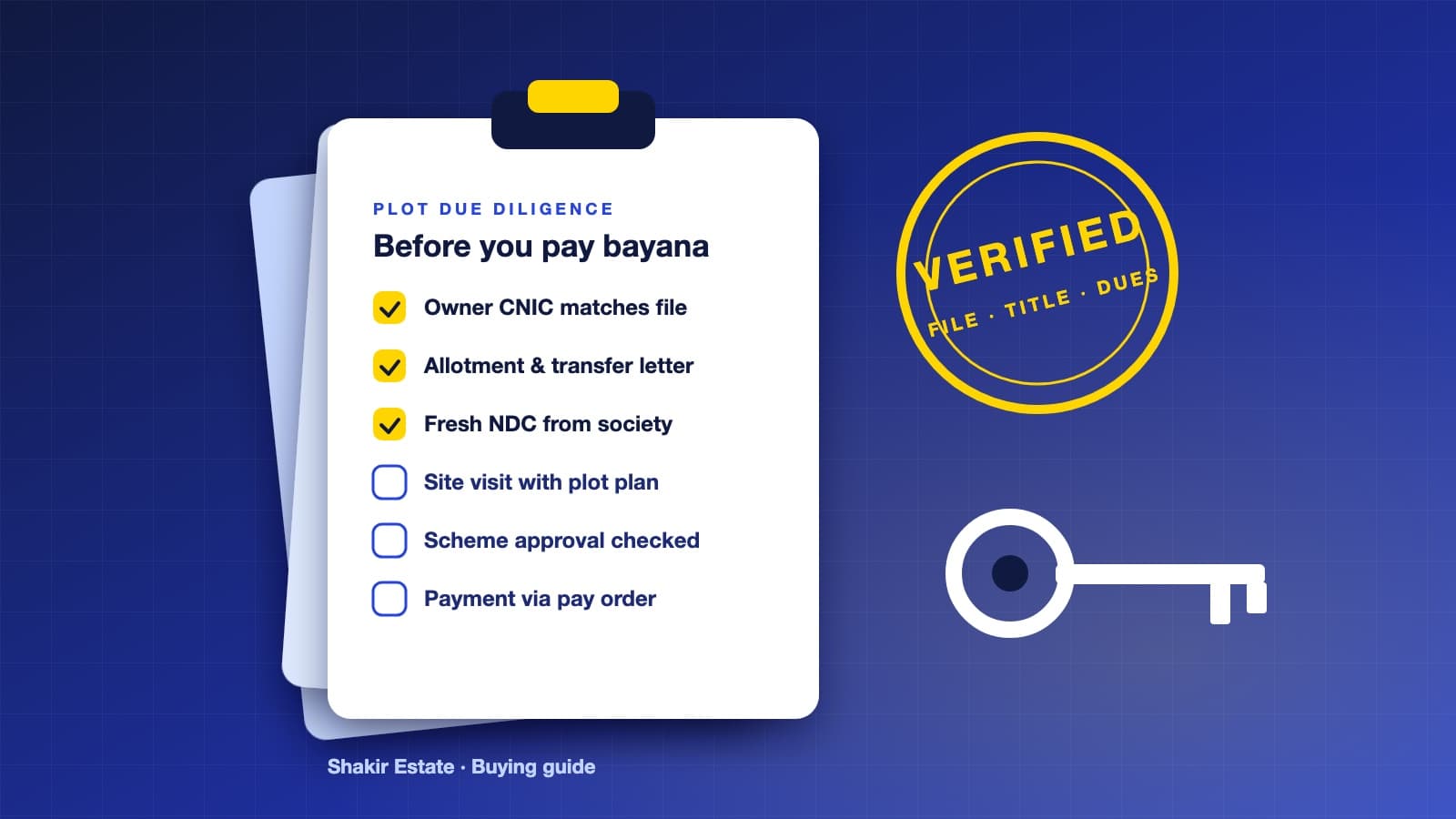
Use this checklist before paying bayana (token/advance money), and again before the final transfer.
1. Verify the seller and the title
- Match the CNIC of the person in front of you with the name on the allotment/transfer letter. If an agent or relative is selling, demand a valid, verifiable power of attorney and confirm it with the society.
- Confirm ownership directly with the society or authority. Visit the society's transfer office (or official owner-verification service where available) and confirm the plot is registered to the seller, with no pending transfer in process.
- Check for duplicate files. Ask the society whether the file has ever been reported lost or duplicated, and whether any court order or lien is recorded against it.
2. Read the file documents
Ask for, and actually read:
- Allotment letter / intimation letter — the original allocation of the plot.
- Transfer letter — showing the current owner's name if the plot has changed hands.
- Payment schedule and receipts — for plots on instalments, exactly how much has been paid and what balance transfers to you.
- No Demand Certificate (NDC) — issued by the society, confirming no outstanding dues, development charges or surcharges. Insist on a fresh NDC; an old one proves nothing.
- Site plan / plot location certificate — confirming plot number, block, dimensions and any extra land.
3. Verify the plot itself
- Visit the plot physically — with the site plan in hand. Confirm the plot number on the ground matches the file, and note the surroundings: filled or low-lying land, distance from the main gate, nearby amenities and nuisances.
- Confirm possession status. "Possession" means the society has handed over the plot for construction; "non-possession" plots usually trade lower and carry development-timeline risk.
- Check development status of the block — roads, electricity, gas, water and sewerage. Promised development and delivered development are priced very differently.
- Ask about extra land. If the plot includes extra square footage, confirm how the society charges for it at transfer.
4. Verify the society's own status
A clean file in an unapproved scheme is still a problem. Confirm that:
- the scheme is approved by the relevant development authority for your city, and
- the specific phase/block you are buying in is covered by that approval — some societies have approved and unapproved sectors side by side.
Where a regulator publishes lists of approved and illegal schemes, check them yourself rather than relying on marketing material.
5. Structure the transaction safely
- Put the agreed price, payment schedule, transfer date and penalty terms in a written agreement to sell, witnessed and signed.
- Keep bayana proportionate and documented with a receipt.
- Make the balance payment at the time of transfer through banking channels — pay orders or demand drafts in the seller's name, not cash.
- Complete the transfer at the society's transfer office, collect the new transfer letter in your name, and obtain your own NDC and receipts.
The golden rule
Nothing in a Pakistani plot transaction is urgent enough to justify skipping verification. A genuine seller with a clean file loses nothing by giving you a few days to confirm everything in writing — and a seller who pressures you to skip the checks has told you exactly why the checks exist.
Wondering what your plot is worth?
Get an AI-generated market estimate backed by current research — comparables, rates and sources included.
Estimate My Plot Value